
Trummy Young
Melody and Joy

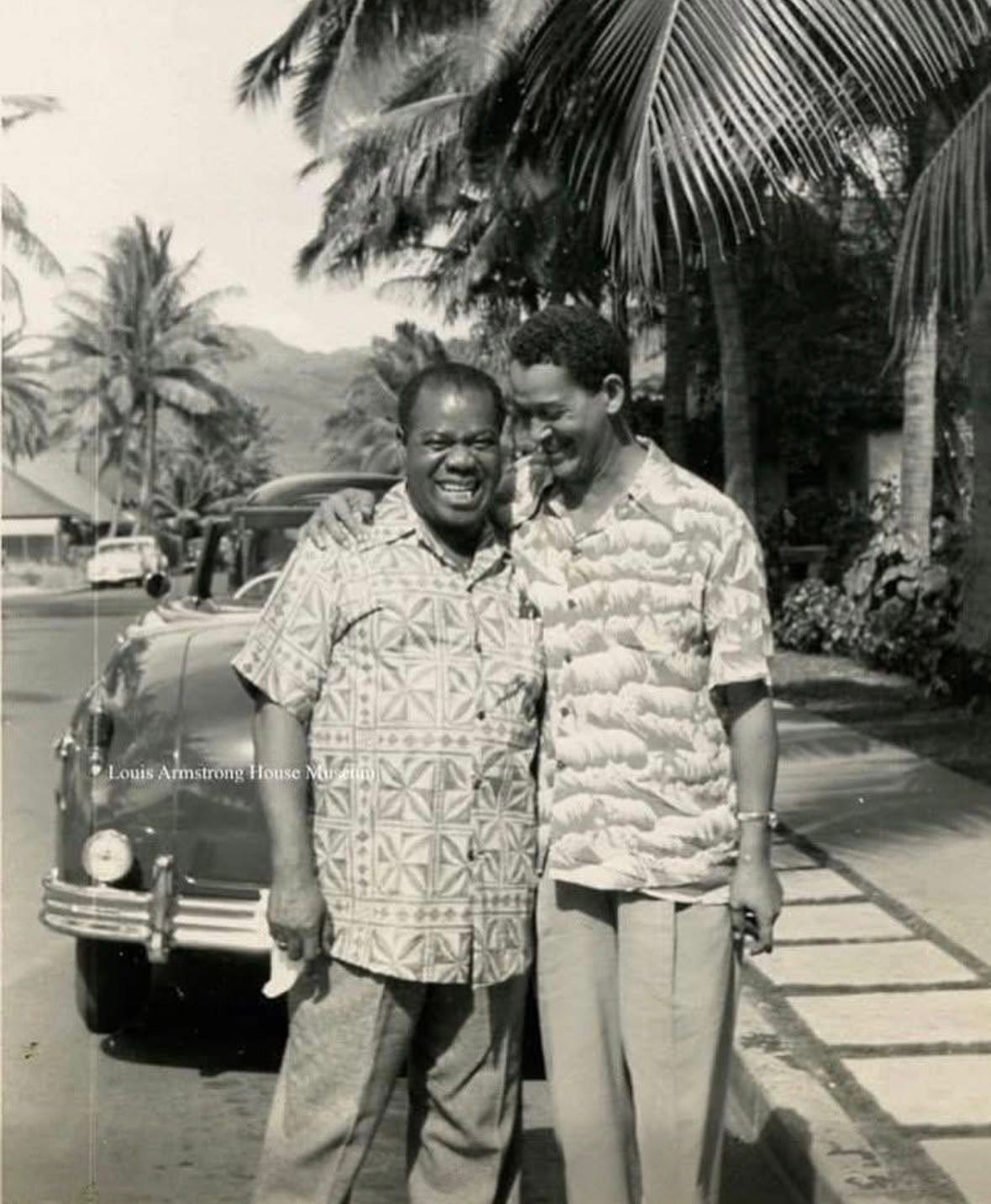
Trummy Young is one of the great kings of the trombone. Like most of us, I first and mostly heard him with Louis Armstrong. History will remember him for that, but there’s more to his great musical story. From his earliest days he had a huge and original sound. He is also one of the few masters who’s singing was just as on point as his playing. With his priority to reach the audience above all, he was literally the perfect musician to stand next to Armstrong. Who else in jazz history went from the center of the swing era, to playing with Bird and Diz, to then Louis Armstrong? In addition to all of this, he was also a composer of hit records.
Trummy was born James Young in 1912, and at 18 years he got his start with Booker Coleman’s Hot Chocolates. Working with The Hardy Brothers and Tommy Myles followed. It was Myles who gave him the nickname Trummy which seemed to truly outright replace his name. The name itself has an unknown origin other than the Tr from trombone and yummy? Maybe they know more over at The Louis Armstrong House. In 1933 Myles arranger Jimmy Mundy left to go with Earl Hines, and with an open trombone chair, Trummy joined him. The way guys jumped around in the swing era, bands and leaders seemed like baseball teams and managers. Trummy was 21 and now on the main stage with Hines until 1937. I tracked down a great solo in 1934 on the Mundy arranged Copenhagen. Coming out of a modern Hines solo, Trummy enters with a nice lip trill and the sound, style, and even the melodic language he is known for are already present. Bird and Diz were not with Hines yet, but Trummy would hook up with them later.
In 1937 Trummy joined Jimmie Lunceford, and here his vocal/trombone combo put him over the top, just like Louis Armstrong’s 1-2 punch that takes complete control over audiences. Margie was his first hit. The way Trummy sings reminds me of Ray Nance, and that’s were I realized they are both very influenced by Louis Armstrong as a singer, right down to scat singing to fill in the gaps. He even comes out of the vocal with a strong, singing upper register trombone solo to ride the song out, as Armstrong did countless times. In 1939 Trummy and Sy Oliver co wrote the hit ‘Tain’t What You Do (It’s The Way That You Do It) . No bone solo here, but Trummy is featured on vocals. They also did The Lonesome Road in a brisk arrangement featuring the great Willie Smith on alto sax, and a surreal group somewhat dark vocal piece called Cheatin' On Me. In 1939 Trummy also recorded with Billie Holiday, in the melody role before Lady Day saunters in. In 1942 Trummy sang Easy Street with Lunceford, with a nice solo, and especially a brilliantly flexible and ambidextrous solo cadenza to close, check that out! In 1943 Trummy joined Charlie Barnett but it didn’t work out. In 1944 Trummy recorded his song Thru For The Night with Cozy Cole, taking a solo with so much of a vocal approach you can almost hear his speaking voice, and with Coleman Hawkins on tenor to boot! I also found a V-Disc with Trummy. In 1945 Trummy joined Benny Goodman. They had a No.2 hit, but for some reason on the track I located, Benny himself "sings" . Listen only if you want some stale toast, with zero butter.
It’s from 1944-46 that we have tracks available with Trummy as a leader. He sings on many of these tracks, but on the instrumentals I think we can get a taste of what his playing was like with Jazz At The Philharmonic, which I could not track down. On the link above be sure to check out the first track Hollywood, where Trummy plays with a fluid agility where he could play bebop, in addition to full soaring high notes. This leads me right to my core discovery in researching Trummy-his work with Bird and Diz. Trummy was a regular on 52nd st and in 1945 he recorded with The Clyde Hart All Stars. Good Bait has Trummy with Dizzy Gillespie and Don Byas. His short but adventurous solo seems to be inspired by Diz. Though he just takes one pass soloing on the bridge, you can’t get much more bebop than Salt Peanuts. Absolute peak is Trummy leading a group with Charlie Parker and Dizzy trading 8’s on his piece Sorta Kinda! Trummy sings here but his opening trombone improvisation says it all. Trummy elaborated further on bebop from an interview discovered by Chris Wiley at Commander Trombone. In regards to the new style at the time he said:
It affected it. It’s bound to affect it. I played things that I didn’t realize I was playing a lot of times because it was an influence from the guys that I played with. But I never did deviate too much from my original style. But you incorporated certain things. Without changing the style. You don’t even know you’re doing it. If you play with a guy like Dizzy and a guy like Bird, you’re bound to pick up a few things automatically. You don’t realize you’re picking ’em up. And every once in a while you hear a guy say, ‘Hey! Trummy! I didn’t know you played modern things!’ I say, ‘I don’t’. He’ll say, ‘Well, listen to this. And he’ll play something that I just without thinking unconsciously played because it’s so embedded in my mind from hearing it with these guys.
What I loved about Louis was he was melodic. I’ve always been a melodic guy; I’ve always loved melodic things. I’ve never been a guy that played a lot of exercises and things of this sort, but I’ve always been a melodic player. Now, I’ve looked at various styles of playing. Now, Bird, with all the playing he did, it was melodic. Stop and think of that.
There it is. Long have I believed that Bird was one of the great melodic masters, and here Trummy brings Bird and Louis Armstrong together, as melody was intrinsic to them both in different ways.
In the early 50’s Trummy got married and moved to Hawaii, but in 1952 he got the well known call to replace Jack Teagarden with Louis Armstrong’s All Stars, and for the next 11 years made history as one of one of Armstrong’s closest musical partners, if not the closest. This period in jazz history is well known and documented, so I’ll just go through my own favorite moments, of which there are many. With Louis is where I first heard Trummy when I fell in love with jazz in high school in the 80’s.
Almost everyone agrees that their top recorded moment was the album Armstrong Plays W.C. Handy, and from that album my go to for years must be Chantez Les Bas. Of course Trummy’s solo on St. Louis Blues. The way Trummy ROARS here, in extensive video watching of this band, this was his natural state. Trummy was always amped and ready to go on a dime, yet always in constant unyielding loyal support of Armstrong. Their bond was clear throughout the immortal Satch Plays Fats. The ultimate example of this is here on video as Armstrong calls Trummy “Bing Crosby in technicolor” on the BP Supershow where they sing a duet. In 1956, they did St. Louis Blues with Leonard Bernstein! Here’s a clip of Trummy with Louis in the film High Society. Dig Trummy on the Ed Sullivan Show with none other than Duke Ellington and Louis together on In A Mellow Tone. A rare appearance by Trummy during his Armstrong years was here with Buck Clayton on How Hi The Fi, burning down the house once again.
As Armstrong’s Hello Dolly started to take off as a hit, Trummy decided he had enough of the road and returned to Hawaii. I was staggered to learn he was only 52 at the time, as he had already lived so much life. He spent his remaining 20 years playing, but on his own terms when everything was on point, with no more year round touring. I also noticed he didn’t just keep his chops up, he remained at full power. I found 2 notable live videos. The first one is Sometimes I'm Happy with fellow trombone king Vic Dikenson. The second and perfect finish for my stack is Trummy all the way in 1984 featured on If I Could Be With You (Just One Hour Tonight). This last one really shows how Trummy both sang like he played, and played like he sang. At the core of both he just had an uncontainable and indestructible joy in life. Trummy rose above and back to jazz heaven that same year.
For Trummy Young
Thanks for reading and I hope you dug it. Subscriptions are absolutely needed and appreciated. Next week another new release feature: Steve Hirsh and Daniel Carter and their new album Convocation on the Mahakala label.
Special thanks to Scott Yanow and Chris Wiley for their essential research as a guide to this weeks piece. PEACE
Again, great work Matt. I was informed , entertained, and edified by your discussion on “Trummy”. He is a legend that deserves wider recognition; I fear his luster and influence is fading due to the commercial success afforded modern copy-cats that have lifted his:Armstrong, Ellington, and Eckstine to an historically obtuse audience.