
Sonny Rollins: Mission Complete
"We can make things celestial." - Sonny Rollins

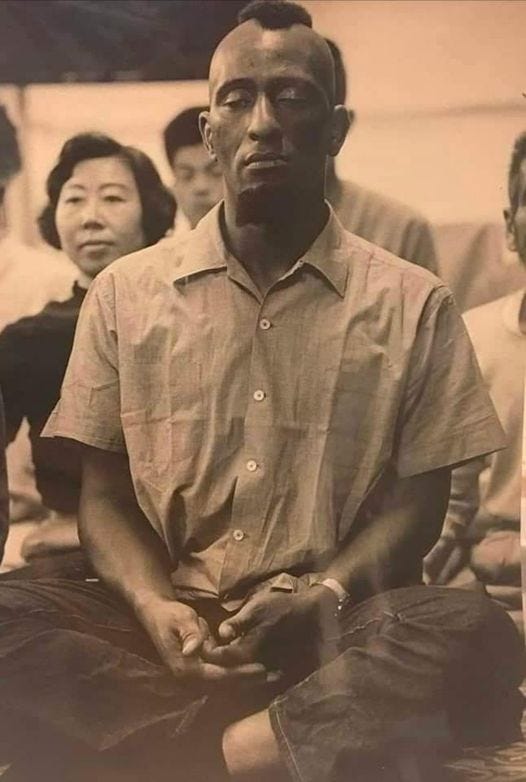
Indeed much has been written about the passing of Sonny Rollins, much of it within 24 hours. I’ve been writing in my head all week at work and Sunday is the day to reflect. Like I said to an audience I played for on Wednesday, Sonny Rollins transition is so large an event, that you can see it from space. The spiritual and musical cavern he left is vast.
The first Sonny that reached me was his solo version of Body & Soul. As a burgeoning musician, the clarity and coherence was planted in my musical DNA, where it resides permanently for all of time. It was Sonny here that actually helped me to hear Bird clearly. Soon after, I realized that here was a hero that was still with us. I was an art student at Suny New Paltz when Sonny came through. Backstage I asked him the ridiculous question who was taller, him or John Coltrane, as I was also deep into Trane at the time. The lessons and directions in their music have made such impact, that all jazz musicians have to keep listening and process it all out for themselves over a course of years. Sonny was actually cool with the question and answered it honestly. I even apologized afterwards, but he said “I get it.” To redeem myself I asked him about Clifford Brown and Sonny said that Clifford was a beautiful person. He added that since I played the trumpet, Clifford was a true example of doing the work to become great. A friend of mine, a tenor player, gave Sonny roses.
Years later after a failed bid in the straight ahead battleground, I was working as the jazz manager at Tower Records at Lincoln Center in NYC. I was asked to be Sonny’s assistant at an autograph signing and grasped the opportunity with a tight fist. When I arrived he was seated in a closed off area at a table with 2 chairs and I pulled up. I had planned what I would try to talk about and nervously said my favorite Sonny Rollins moment was Three Little Words. I had no idea Lester Young was fond of the song and it’s wonderful lyrics. I was all about the stunning level of in the moment improvisation. Sonny was wearing shades and looking in another direction, but when I said that he turned and lowered his head, making eye contact, and said:
“Me too man, that was one of the good ones.”
Soon after a woman entered that Sonny knew and I disappeared from view. I had received an incredible gift, and insight into his relationship with his music.
I kept listening of course, and will continue to listen like all of us today. I saw him at Bradley’s in the Village. My supreme Sonny listening experience was up next on August 10th, 2004 at Lincoln Center, right next to my job. Sonny was playing a free outdoor concert and everybody in my crew was buzzing. In a moment I’ll never forget, I met up with Daniel Carter, Sabir Mateen, and Ras Moshe, all deep tenor saxophone players, to witness the king. The sky was so overcast that I was scared of a rainout, but Sonny forged ahead. During the music Daniel was being very vocal about how he felt about the music, and a woman nearby made the mistake of asking him to stay silent. Don’t take us out of the Sonny zone. I’ll never forget how Sonny went from musician to musician to trade improvisation, to talk to them. Sonny was so hardcore that he traded with the percussionist on a ballad!
As the music continued, the sky darkened and became ominous, and the wind picked up. Sonny continued on. He launched into a solo cadenza deep into the set and as he did, he was in commune with nature. The clouds would not break. The heavens above literally parted in this moment. After the concert, a brilliant sunshine spread across Lincoln Center. I had seen with my own eyes what I heard Sonny speak about: the big picture.
Afterwards, we went to my spot, I lived at 50th and Broadway. I remember Daniel saying that Sonny was far beyond any notion of free vs. straight-ahead. He was Sonny. Sonny himself said years later that however people view him, he was happy to sometimes be considered a free player.
Sonny’s relationship with free jazz is something I have studied for years. A vital connection point that for me unites jazz like nothing else. For a musician like him, a true master of rhapsodic melodic improvisation that transcends all boundaries to take the chances he did just boggles the mind. This is the mark of a true artist. As evidence I present his closing improvisation on East Broadway Run Down. Did anyone in jazz history ever go that hard in the paint?! Sonny went even further playing openly in direct exchange with the father of the tenor saxophone, Coleman Hawkins on the famous Sonny Meets Hawk. Has there ever been a moment in jazz history when someone was so honest about the environment they were in at the time, in relation to the tradition of the music? Sonny answered the ultimate what if question when he could have easily gone straight down the road out of respect. Hawk was the ultimate collaborator having been part of the early bebop movement himself. Sonny didn’t just explore in the studio, he hit the road with Don Cherry, Henry Grimes, and Billy Higgins as is well known. Sonny was down with Ornette and his explorations. I asked OC about Sonny and he said that Sonny asked him to join him playing down by the literal riverside. Sonny’s connection to nature is revealed here once again. The supreme example will always be Sonny playing out on the bridge.
In a joint interview with David S. Ware (thanks Matthew Shipp and James Keepnews for sharing), Sonny elucidated on the idea:
FM: Sonny, you said once in an interview: the saxophone is an open sky...
SR: Yes that's true. But you know Franck, I think that what I meant was "music is an open sky. I think that the real, well expressed thought from me could be interpreted as the saxophone is an open sky; that would not be far from the mark...
Here I would suggest a book with that actual title by Eric Nisenson.
Sonny Rollins was a truth seeker and messenger at the same time. He was never afraid to give it all to the search for deeper human meaning through music. In the same interview Sonny said:
“We can make things celestial. If you look around in this world, nature, even a beautiful city like Paris which is the most beautiful city of the world, it is just concrete, so you need, it's so much more to it. And music sort of, is definitely a bridge to other things, if you can use it. Music is also providing people in another way, which is very good, people enjoy music when they are going to work, music helps them at that level just. But going to more profound levels, so it can also, like you said, depending on where your mind is and under, and music, what it can bend to, it is more than just a pleasant way to live in this world. Much more than that.”
The last time I saw Sonny was at Ornette’s funeral. I was sitting with Hamiet Bluiett in the middle somewhere before it began. Ornette’s saxophone was on a stand that I had just given to Denardo.
The whole church went quiet and turned back, looking to the entrance.
Sonny Rollins walked down the center aisle, and as he did a legion of jazz musicians spiritually bowed in respect.
*
Now the world sees.
Sonny Rollins, his mission complete, has left us with his music.
Sail on, saxophone colossus..
Now and forever..
*
For Sonny Rollins
Your best post yet. It has been made clear this week that there was something about Sonny Rollins that lifted all boats.
Beautiful tones, Matt. You captured so much of him.