

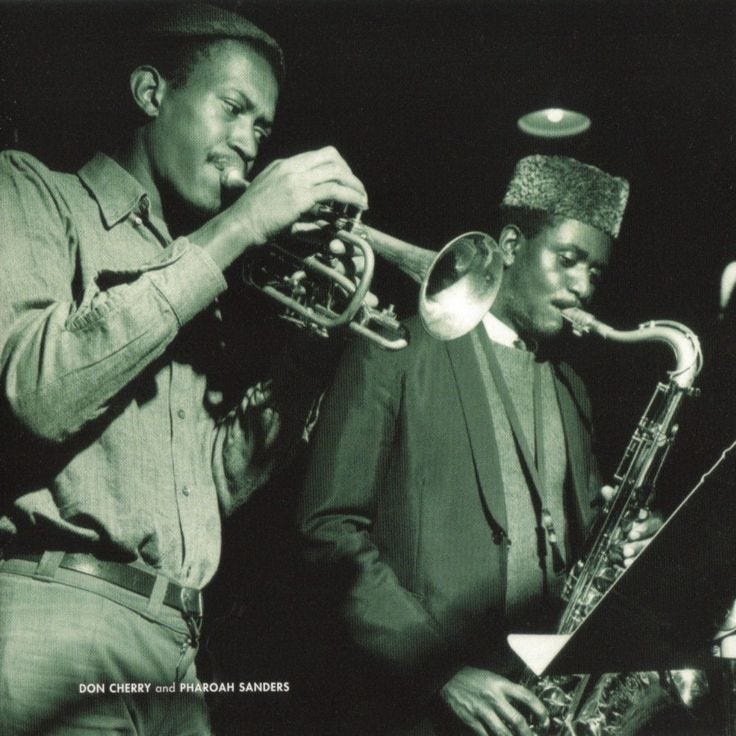
When I talk music with the tenors in my life, we often get into how Don Cherry played with all the great tenors of the 60’s and beyond. That both Sonny and Trane played with him is enough for most, but a closer look reveals 19 tenor players and counting. In academia, I encountered shade towards Don, as he doesn’t play the role of what your supposed to do. To stand with a tenor titan playing trumpet on the front line of the music calls for spiritual, musical, and indeed physical strength. Don and then Roy Campbell Jr. after him had all three. I discovered these mountain tops as a sideman with Sabir Mateen. When Ribas hit the zone into the impossible, I had to enter my own. Standing with musicians who live and play on their own mountain peak in the sky has profound meaning.
I’m not going for a hard jazz history exact chronological document here. I hope to discover a highlight and way to go for each reader and listener feeling the exchange between Don and each tenor master. Most of all I hope to learn more about Don.
All though Don’s tenor journey may be thought to begin with Ornette, in 1959 he recorded Ornette’s piece Focus on Sanity with John Coltrane. Some people feel Coltrane was being restrained here, but he’s whirling on the opening solo. I don’t think he’s holding back as much as people suggest, maybe the transcription people out here can take a closer look. I get the vibe that he’s visiting the OC world through Don. Don is in the pocket but open to exploring, especially in his second solo. I believe Trane also responds with more openness here, as if he had been at OC’s house a few hours. I can hear the OC influence on both of them here.
in 1961 Don recorded on the famous Ornette on Tenor album, a favorite among musicians. Check out how the band switches up with Don’s vibe on Eos. I’ve heard many times where rhythm sections drop everything and follow Don into a new world when he plays. Eos has a perfect segue. Don was always exploring but deeply listening, and always gave the bass and drums ideas to work with. While at times he would push the exploration vibe hard, he would also co-create. There’s such a vital lesson here on free playing that’s it’s not just whatever you want, it’s creating together. More than that you can feel how the musicians like creating and swinging with Don. Charlie Haden, Jimmy Garrison, and Ed Blackwell and so many others. Sometimes the joy in music is how we respond to each other, and venture where we might not go without a friend.
In 1962 Don recorded live with Sonny Rollins on the famous Our Man in Jazz. Leave it to Sonny who in reaction to the avant-garde at times went further than anyone else. Question for jazz scholars: was Sonny headed out on his own no matter what? Either way, Sonny met the movement on his own terms, and being himself, as on the 25 minute Oleo that opens the record. Don is right there seemingly representing himself, the movement, and even jazz history all at the same time. How could anyone stand with maybe the deepest and truest improvisor of them all cutting loose in the moment? Sonny clearly had to get this stuff out. Don steps right into Sonny’s space around 8 minutes. Sonny does his improvised background thing before handing the baton to Don entirely. Don starts sweeping, cascading, and dancing around the whirlpools edge.
Jim Macnie asked Sonny about Don, and his response says it all:
Don and I would practice together, just he and I. Great fun. He had a fantastic musical imagination, musical mind. He always kept things on a creative, unplanned level. Spontaneous.
Sonny elaborated further to Bret Primack in an essential, wonderful recollection of Don.
Up next, Don’s tenors he called as a leader in recordings. In 1964, Don had his first steady group, captured live in Paris with Gato Barbieri on tenor saxophone and Karl Berger on vibes. To my ears I immediately recognize Don the composer on the album Togetherness. Gato was still breaking free from the influence of Coltrane here. Don is his fully formed self walking the tightrope between structure and freedom in a way that so many of us have been doing ever since. I have my own history with master Karl. In my school days I ended up on a jazz workshop with him and nobody else showed up, twice. One session was he got out the real book and fixed all the chords to what Monk actually played on piano, and it went completely over my head. Decades later I played in his orchestra which was a fantastic learning experience. The first set we learned the music without paper, and the second set we played. Karl was at odds as what to do with me as I was stuck in a swing cornet phase. I quickly learned he was way more into Kirk Knuffke, who I was subbing for but didn’t know it. I tapped out, but did give Karl a melodica, though he didn’t vibe with it. This wouldn’t be the first time I got fired/replaced for brass players that leaders liked more than me. I got replaced by Peter Evans once, and hey I would make the same call and replace myself. I think Pete might actually be a trumpet come to life.
In 1965 in Copenhagen, Don hooked up with tenor sax player Mogens Bollerup for a fairly straight ahead session called Cherry Jam. I hear some Trane influence on Bollerup.
In 1966 Don debuted as a leader on Blue Note with the famous Complete Communion, and Gato returns. The tightness they share on the music is palpable. Man, that first Don solo- risk and dance and wider intervals than any other trumpet player dared to play with. Gato is free of Trane here and pushing outside more aggressively. The music makes me think of my favorite Don quote: “Music should never sound written down.” This music is very natural with structure that doesn’t impede. I think playing like this calls for time to develop that is hard to find in 2026, but still possible. Sometimes it’s already there with the right folks. Gato, Karl, and Don were back at it on the essential Live at Cafe Montmartre 1966 , cutting loose but still “organized”. In 1967 Don released the incredible Symphony for Improvisers with Gato, Karl, and Pharoah Sanders taking his concept further still. I will suggest it’s Pharoah on tenor at the 29:00 minute mark. He plays fluid piccolo on the album. Having 2 big power tenors at the same time, and such seamless transitions, I’m still learning Don. On Symphony for Improvisers jazz becomes itself.
In 1968 Don teamed up with Swedish tenor play Bernt Rosengren on the Brotherhood Suite. Rosengren also appears on Live in Stockholm and then Eternal Now in 1973.
Don’s full on tenor moment with Pharoah came in 1969 on the invincible Where Is Brooklyn? , a favorite of the tenors in my life as well. Pharoah is full bore, and takes the first solo on the album splitting light, yet finds a way to interject lyricism even at the center of the storm. Ornette called Pharoah the best tenor player in the world. Don responds in way that I can hear his influence on Roy Campbell Jr. that I never quite heard before. I was blessed to walk across town with Pharoah once carrying his horn on a very cold day in NYC. What made this memory bizarre is we walked in front of the Dianetics tower in Times Square and the actor Zach Galifianakis was tripping on the video they play outside. I said “I can’t wait to get out of this cold”, and Pharoah said, “Not me, I want to feel it.” However small, I felt this was a window into his universe.
In 1973 Don recorded with tenor saxophone player Frank Lowe on the massive Relativity Suite. I believe Frank takes solos on the first 2 pieces. In 1975 Frank returns with Don on Francois Grillot’s favorite Don Cherry record, Brown rice. Don created his own personal universe on Brown Rice. Jazz scholars, was Miles Davis electric funk an influence? Frank Lowe had his universal light splitting upper atmosphere tenor and at 29:30 on Chenrezig he soars. Don doesn’t break the song undercurrent leading to a deep immersion and co-existence that is extreme humanism. To hear Frank Lowe and Don on a more straight-ahead side check out the fascinating Lowe album Decision in Paradise. This amazing event is a chance to hear Charles and Charnett Moffett together, and with Grachan Moncur III and Geri Allen on board? Leave Substack now and go scope it out.
I can’t front that I was surprised to find tenor player Michael Brecker on the list of Don’s tenors on the album Hear & Now in 1977. His tone is unmistakable on Mahakali. The entrance of fusion rock guitars, I didn’t see it coming. Hear & Now has a universal Don cherry weaved world tapestry with a hugely positive overall feeling that Don seems to be feeling on the cover.
Fast Forwarding to 1988, 52 year old Don mellowed out somewhat, at least for the album Art Deco with Charlie Haden and Billy Higgins. He had tenor player James Clay from Texas on this one. That open Don sound with harmon mute on Art Deco is iridescent. Mr. Clay described himself this way: "Texas tenors are known for playing in a raunchy, straight-forward manner, with lots of emotion and few frills. I'm a typical example of that style of player." He was not tearing any roofs off here, but a welcome visitor to Don’s house.
Dona Nostra on ECM was Don’s last recording as a leader. He had tenor player Lennart Aberg. Don clearly trusted Aberg and gave him space. Aberg is thoughtful and considerate in what feels like Don’s last chapter in music, and life. There’s a time to say goodbye vibe on M'Bizo. I can’t deny hearing a strong Wayne Shorter influence on Aberg.
Now to rewind and get into the tenors Don collaborated with, but not as a leader (besides Sonny and Trane) These are all known names in the jazz world, and additionally contribute to my idea that Don played with all the great tenors of his day and beyond.
The great Albert Ayler had the 2 Don’s, his brother Donald Ayler, and Don Cherry as his brass players at different times. They took vastly different approaches to enter Albert’s spiritual whirling whirlpool of joy. Don Cherry is on 4 albums with Albert. I’ve selected Infant Happiness as the link here. Don enters Alberts space in the incredible wind and rain of Sunny Murray and Gary Peacock. He maintains his own identity but clearly reacts to the vibe. Don was fully in the Albert universe. So much so, that here in this incredible interview he takes the listener into the feeling of what it was like to stand with Albert playing music. Don was spiritually able to enter the space, and said that Albert “carried the gift, and the voice, and reflection of God".
After Don left Sonny Rollins group his next step was the legendary New York Contemporary Five. This 3 horn super group was with Archie Shepp on tenor and John Tchicai on alto with bass and drums. The flip is the repertoire, with originals by all 3 horns, but arrangements of Monk tunes also included like Monk’s Mood and Crepuscule With Nellie that they didn’t solo on. We have a full live set from 1963 in which to indulge. This was a tight group, not as open as Ornette’s work. It was more digestible to those unable to grasp OC, but they still had an edge with the 3 strong, unique, different horn voices. In my personal life I have crossed paths with the legendary Archie Shepp 3 times. I quickly learned that Archie could detect fakeness instantly, and that I was seen as real. My favorite memory is that Archie was trying out a new horn while I was at Roberto’s Winds in NYC. I sat outside the room and listened to him improvise on tenor for almost an hour.
Old and New Dreams is a major long term ensemble for 11 years from 1976 to 1987, but only had 2 studio, and 2 live albums. This makes tenor player Dewey Redman the musician who played tenor with Don more than anyone else I believe. In a quartet with bass and drums, Don and Dewey broke some serious bread. With Ed Blackwell and Charlie Haden they took the core swing and melodic improvisation pillars from OC and churned on, continuing to explore along the way. Ornette was deep into Prime Time during these years. On Open Or Close the OC influence is strong. The way Don can jumble and spiral notes but leave space between them and pace it all out can be intoxicating in the best way. Sometimes Don pushes through lines and paints shapes, a concept I learned from Philadelphia great Bobby Zankel. Here’s a great video of Old and New. Check out Dewey's Tune live.
Check out Don from Old and New Dreams doing a lecture and breaking down the core of harmolodics at Harvard University!
Going down the tenor spaceways, in the late 50’s Don was a sideman with tenor player Charles Lloyd in Los Angeles, but I haven't located any audio or video.
In 1963 Don worked with tenor man Clifford Jordan on the free blowing album It Is Revealed. Prince Lasha and Sonny Simmons were also on board. In 1969 Don was on one track, the opener titled Vienna on Jordan’s album In The World . He plays strong and maintains his identity strongly over the changes and form.
In 1968 Don joined tenor sax player Charles Brackeen on his debut album on Strata-East titled Rhythm X, though it was released in 1973. In the 80’s Brackeen made a series of powerful records on the Silkheart label.
Don led a live album in 1987 with 32 year old tenor player David Murray titled Inside/Outside. David roars on Last of the Hitmen before Don lays in the cut with the harmon. Don remains one of the few trumpet players able to dodge Miles with a harmon. Indeed, the David Murray bass clarinet is in top form on Pettiford Bridge. This is simply a great moment for the BC!
From tenor great Charlie Rouse’s last album Epistrophy in 1989, seven weeks before his passing, Don plays on the last two tracks. What a trip to hear Don come in around 10 minutes with harmon mute, and work through the changes on Round Midnight while once again staying himself. No matter the environment Don was true to himself. Again on Epistrophy Don handles Monk changes entirely as himself.
My final tally is about 19 tenor players that worked with Don, but that was never really the point. By taking a closer look at Don I have discovered that there is so much to learn and hear. I’m just scratching the surface of course.
I leave folks with Don Cherry & The New Eternal Rhythm Orchestra playing Humus - The Life Exploring Force. Peter Brötzmann, Willem Breuker, and Gerd Dudek are all on tenor.
Don Cherry climbed his own mountain in life. While many of us may be climbing to meet him at the top, I’m betting he moved on long ago. His message of humanity and universality is direly needed in 2026. He left his music as a giant signpost to the world to try and remember where we come from and where were all headed. I hope folks dug looking at his music through the tenor lens.
Peace and breaktime here at NSLB.
ML
For Don Cherry
Your material always an insightful read. Thank you!
Two recent books I highly recommend: https://www.blankforms.org/exhibitions/organic-music-societies-don-and-moki-cherry and https://shop.arsnovaworkshop.org/products/eternal-rhythm-conversations-and-travelations-with-don-cherry-and-graeme-ewens
Great essay, Matt! I feel that grandmaster Don still retains much mystery and is surprisingly slept on to this day, as his contributions are monumental. His recollections of the early days with OC in California and Canada in the Eternal Rhythm book are highly intriguing and specific. Did OC ever talk to you at all about Don?