
Convocation
Daniel Carter meets Steve Hirsh

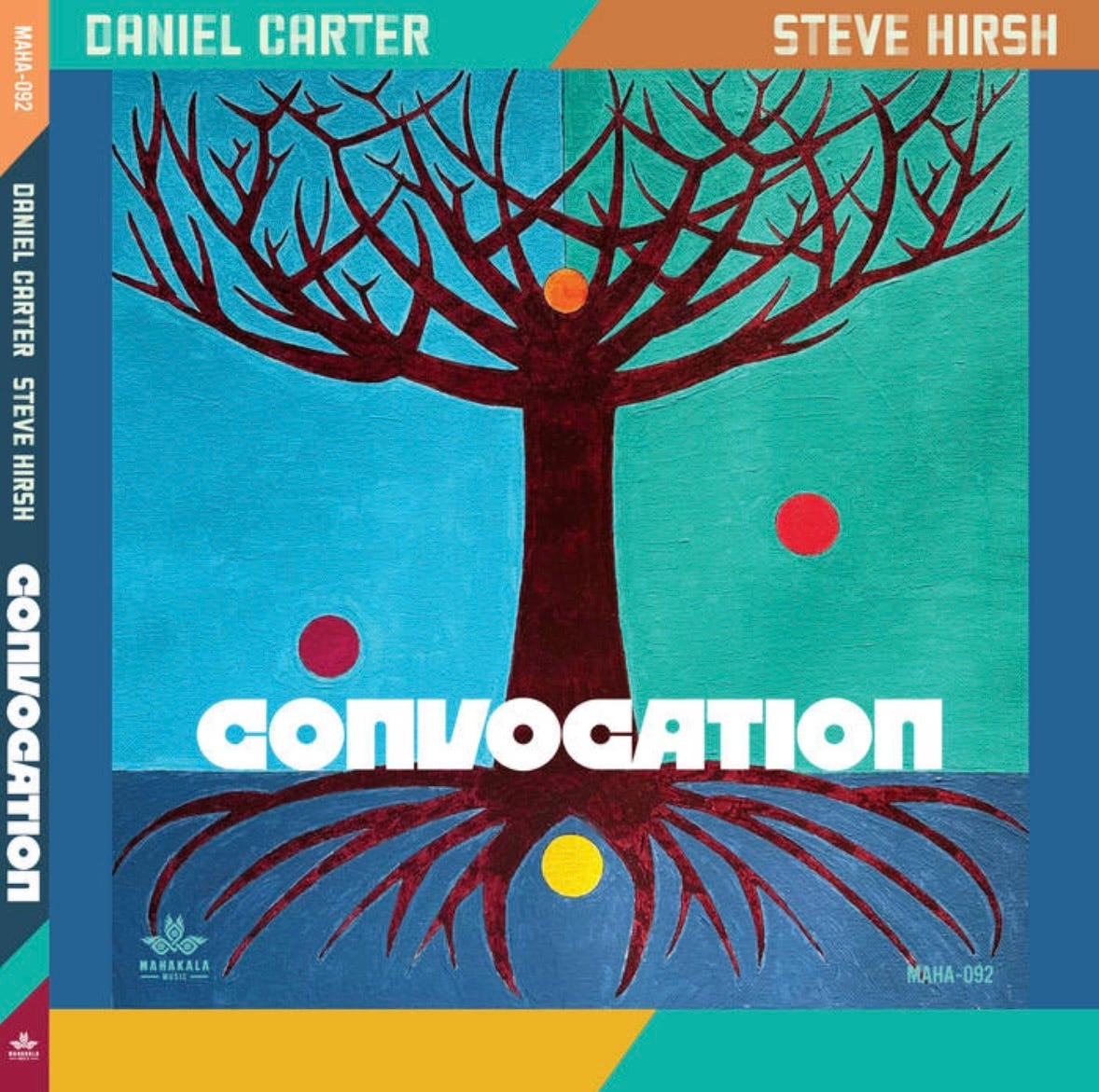
Daniel Carter has been on a life of music mission now for many moons, starting in NYC in 1970 and having just turned 80. Steve Hirsh came up in the late 60’s and early 70’s and made a natural progression from rock to jazz and jazz improvisation. They came together recently for a duo recording on Mahakala, after meeting and playing at guitarist and artist Aron Namenwirth’s home where many like-minded musical meetings have taken place. The music they created together takes listeners to the center of both of their relationships with music, and is aptly titled Convocation.
Daniel Carter has walked an epic path with a legendary openness in search of gold, and as someone who has known and played with him a long time, both he and Steve find gold here repeatedly. While Daniel is always on a perpetual search, Steve is geared in momentum, so on this recording it’s like stepping onto a moving train, though the destination is co-created by them both as they travel. For most horn players, when freed from interaction with another harmonic voice, and in direct engagement with rhythm, the music churns and boils, launched from Trane and Rashied into Interstellar Space. That is not the path here that Daniel and Steve walk. Instead of charging outward, they reverse course and travel inward. Put simply, there is no other horn and drums duo or duo recording like this. Part of the intriguing nature of the music they make is that while Steve is playing openly, he continually has just the right amount of swing, and this brings out more of Daniel’s own inner swing. Steve dynamically moves, matches and blends with Daniel like a like-minded horn player. Neither of them force a direction but allow the music to come to them, embracing the tide, as they both initiate and respond. Ornette wanted to free the drums from role-playing, and Steve has actually done it, while still staying true to himself. This is what the drums can be, but often are not. In this way Steve and Daniel connect on a more personal level as Daniel has always been in search of the possibilities behind what you see up front. What’s really going on.
In the opening piece Leaving Autumn, we hear Daniel’s trumpet with harmon mute. Both Daniel and Ornette have something rare in common. They are not native trumpet players and trumpet ego-chops are not their thing. They also both have trumpet sounds that are completely and utterly them. Daniel leans towards introspection here. Steve brings the train out of the station and at two minutes in they’re moving. Mutes should match the moment, and as the train picks up speed, it’s time for open horn. Steve brings gravitas and urgency into an open realm. I suggest listening with headphones for the full effect, as Steve is able to play such different things simultaneously that it often sounds like two drummers who are really in sync. At 6:45, I was stunned to hear Daniel play the jam session standard Autumn Leaves (!) He turns to the tenor saxophone at seven minutes. In his own musical language he weaves lines with incredible fluency and clarity, as Steve dances on the cymbals with a piano player level touch. The shadow returns and the sun sets, but the journey is only beginning and Steve keeps them moving.
At twelve minutes is their first emotional music discovery. While Steve sets up a peaceful open space, Daniel finds a way to reach into fire-music expression, but at a different temperature than anyone else would ever find. It’s a moment where the past and future exist simultaneously. There is no other musician on Earth who could or would play what he does here. He made it here because he’s playing with Steve. Again, on tenor saxophone now, his sound is like no one else. At 12:50 the moment has passed and check out the subtle swing that Steve plays, which feels like a celebration of the discovery, a feeling that ascends to close out the piece.
Patient playing calls for patient listening. People today often want their emotional needs met immediately when listening to music. Butterfly’s Shadow expands slowly, but then goes deeper and deeper into places for both Daniel and Steve and the listener. The reward is great for those with the courage to stop scrolling and join with them here in a sacred space conversation. The same way clouds move in front of the sun, the way light enters and leaves your room, is the way the music flows here. Steve brings the natural rhythm, reminding us all that we live on a rotating planet orbiting the sun. At 3:30 both Steve and Daniel are locked in-both being themselves at the same time-together. Sometimes Steve can split himself into two different concurrent tempos that are far enough apart as to create a mesmerizing, hypnotic effect. Perhaps that’s how time travel begins. While Ornette wrote Sadness, at 8:40 Daniel and Steve play happiness, and together they improvise a perfect ending. The butterfly found the flower.
Daniel’s piano playing was unexpected next on When Love. More unexpected was where he began, as he played his horn language in single notes. Steve’s brushes ease them in, but they quickly expand and broaden. At 3:30 the wind and rain increase quickly, with the effect no different than when you didn’t know it might rain, and it’s suddenly pouring (but keep the windows open!) Both Steve and Daniel get increasingly percussive here until 5:55 when the storm has cleared completely into a new world that feels like the quiet of outer space-like watching the sunset from the moon. This doesn’t last long however as instead of a train, they now pull out in a rocket ship to speeds faster than those on Earth, until they land their ship on another planet where instead of tree’s they have giant soprano saxophones that people live in. Steve and Daniel remind us that as in their music as in life, change is always coming.
Daniel and Steve both have what I call “the uplift,” always ready to go when the feeling hits. The feeling comes, and they turn up both positivity and urgency at the same time on the aptly titled, Sanctified. The soprano is the youngest of Daniel’s horns in realms of relationship. He doesn’t go down the Trane path, or the Bechet path-it’s D.C. all the way, tone, swing, and everything. Likewise, Steve is playing Steve music, with his personal sound, touch, and swing. Musically they finish the way you see fireworks arc and fall after the pop.
Convocation begins with Steve moving quickly but opening a door at the same time so Daniel can get in. Daniel surprises by getting on board, but with his flute! Flute is one of his most personal voices. Daniels approach on flute doubles down on the different ethereal worlds that the flute can bring us to. He embraces the spiritual and even ancient power of the flute. Steve switches it up and I started hearing timbales from his kit. They then move into a timeless nature that still swings, perhaps a signal that their journey together is reaching the end, but not yet.
At six minutes the trumpet returns to book-end the album. Daniel opens with the harmon stem in, which could be considered aggressive since Miles told all of us to pull it out. Daniel may be searching for something lost there that we all left behind. In time, the stem is removed and the sacred space from the first piece has returned. Steve is not playing a lift-off here as much as a landing and arrival. Their energy is now very different, perhaps only possible after the journey here. Steve plays with a gentle touch using mallets. As he turns the heat on the stove from say 2 to 3, Daniel’s open horn now sings. Their descent to the landing pad is gradual and not rushed. They continue to match dynamics moment to moment, note to note, beat to heartbeat. They land, having discovered a place unknown to all, that only they could find together.
A duo journey complete for all of us to remember..
Convocation is available now from Mahakala Music at Bandcamp.
Album artwork by Matt Lavelle. Cover Design by W.C. Anderson.
Next week, the great horn duo partnerships from then until now. Subscriptions are needed and appreciated. For any NYC readers, I’ll be playing at 5C on Sunday, February 8th at 3pm in a benefit to free Palestine. Peace
Your comment “change is always coming” says it all. That’s the true beauty in the music. Improvised music is truly about being in the moment. After decades upon decades of listening to music, the absolute best is having no expectations and allowing the musicians to do what they do best, express themselves! Late in life I’ve discovered new ways to listen and appreciate. My journey hasn’t even truly begun either! Every note and composition is another opportunity to expand your consciousness!!!! 🙏